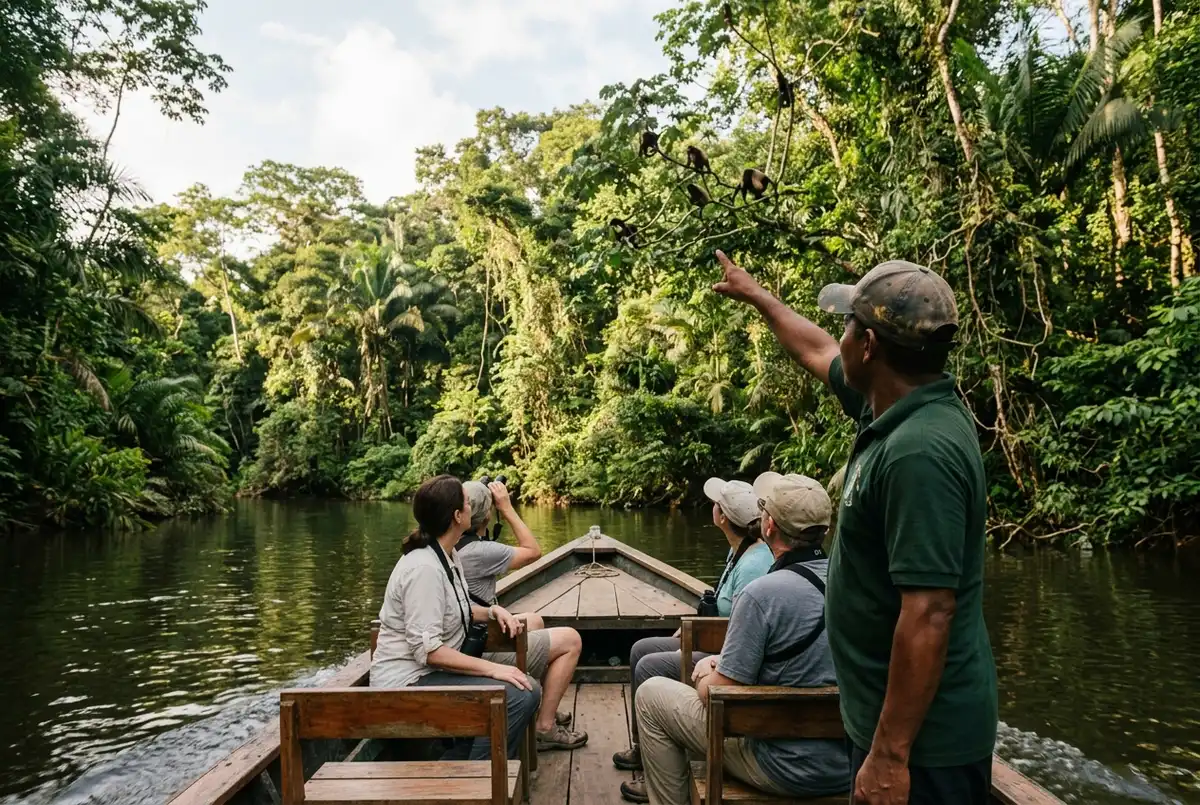
If you are asking where to see monkeys in Panama, the honest answer depends on how much you value certainty versus cost. The Gatun Lake boat tours that visit Monkey Island are the most consistent option close to Panama City, but they are not literally the only place wild monkeys live in the country. I have looked at the realistic alternatives, and I think most visitors are better off understanding the tradeoffs before picking one over the other. For the bigger picture on which species live where, the full guide to monkeys of Panama is the place to start.
Are there actually monkeys on Monkey Island itself?
Yes. The forested islands in Gatun Lake that tour operators call Monkey Island hold resident troops of white-faced capuchins, mantled howlers and Geoffroy’s tamarins, and guides who run this route daily know roughly where each troop tends to gather. This is not a staged attraction with animals brought in for visitors. These are wild populations that have lived on these islands since the lake was flooded in 1913.
What makes the boat tours to Monkey Island so reliable?
The islands are small enough and isolated enough by water that the monkey troops cannot simply wander off somewhere else, which means an experienced guide can find them on nearly every outing. I would call this the single biggest advantage over any land-based wildlife watching option in Panama: you are not hoping for a lucky encounter, you are visiting a location where sightings happen on a predictable basis.
That predictability is why I generally point first-time visitors toward a boat tour rather than a do-it-yourself hike. A short, well-guided trip on the water consistently outperforms a longer, unguided walk through forest where the animals have far more room to avoid you entirely.
There is also a comfort factor worth mentioning. A boat tour gives you shade, a seat, and a slow, steady pace, which matters in Panama’s heat and humidity more than most visitors expect before their first full day outdoors here. A hiking-based search for monkeys asks more of you physically for a less certain payoff, which is exactly the tradeoff I’d want you to go in understanding rather than discovering halfway through a sweaty, monkey-free hour on a trail.
What about Soberania National Park?
Soberania National Park borders Gatun Lake and has its own resident wildlife, including monkeys, sloths and a long list of bird species. Several combo tours route through part of the park on land as an add-on to the boat trip, and independent hikers can also visit on their own.
I would treat the park as a genuine but less certain option. Sightings here depend on timing, trail choice and a fair amount of luck, since the forest is far larger and less contained than a small island cluster. If you are an experienced hiker who enjoys the process as much as the result, the park is a rewarding half-day on its own. If a guaranteed monkey sighting is the actual goal, I would not rely on the park alone.
The practical difference comes down to how the two experiences are structured. A boat tour puts you on the water, moving slowly along a shoreline a guide already knows well, with the whole group looking in the same direction at the same time. A national park hike puts you on foot, covering ground rather than holding position, which is great for variety but means a troop can simply move away from the trail before you reach it. Neither approach is wrong, they just suit different kinds of travelers and different tolerances for uncertainty.
What time of year gives you the best odds, wherever you go?
Panama runs on two broad seasons: a dry season from roughly January through April, and a wetter season for the rest of the year. I would lean toward the dry season if your schedule is flexible, since lower humidity and calmer water tend to make both the boat ride and the sightings themselves more comfortable, and lake levels are usually a touch lower, which can concentrate wildlife activity closer to the accessible shoreline.
That said, I would not rearrange an entire trip around this. Guides on the Monkey Island boat tours report consistent sightings across both seasons, since the resident troops do not migrate away in the wetter months. Rain mostly affects comfort, not whether the monkeys show up. If you are traveling in the wetter season, I’d simply pack a light rain jacket and expect an occasional shower rather than worry that the trip itself will be a wash.
Is Gamboa itself a place to see monkeys, or just the launch point?
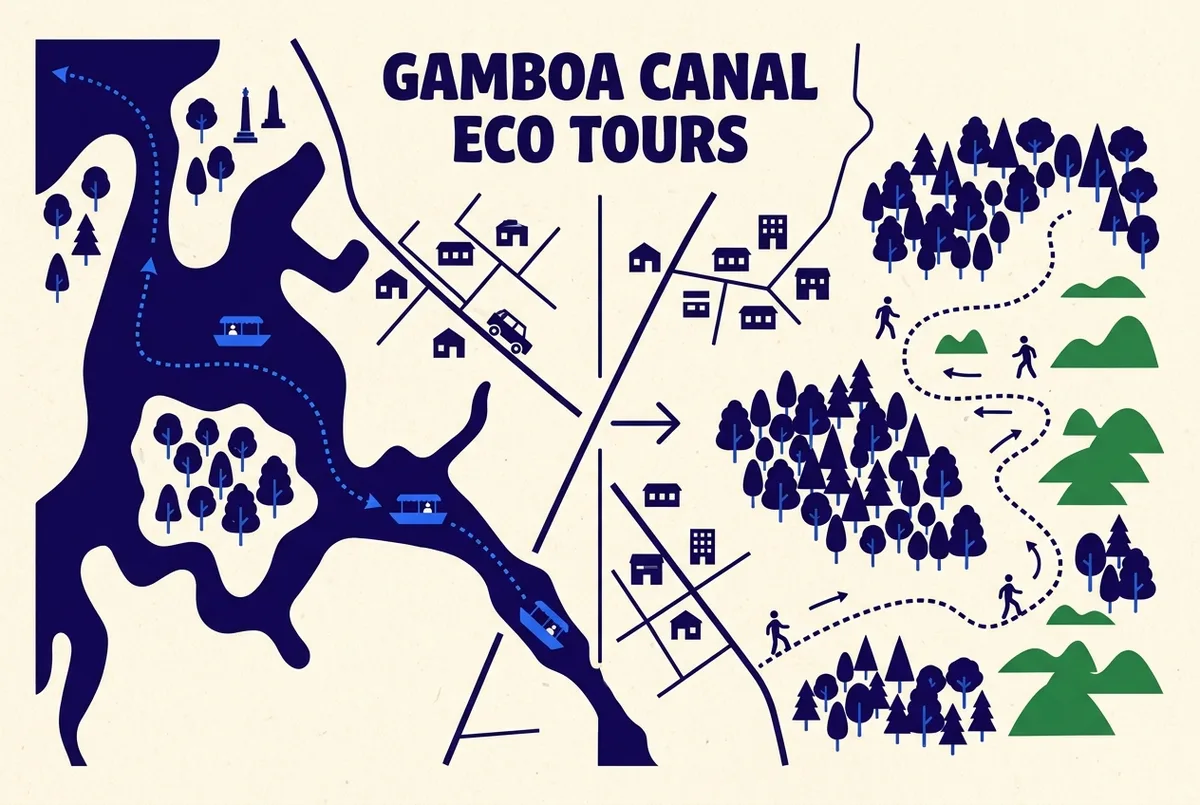
Gamboa is mostly the launch point. It is the small town where every Monkey Island boat tour departs from, and the surrounding area does have its own wildlife, but Gamboa as a town is not where the reliable monkey sightings happen. I cover exactly how Gamboa connects to the islands and the broader route on this dedicated page, including the difference between the public marina and the pricier Gamboa Rainforest Resort tour that some visitors confuse with it.
Can you see monkeys from land without booking any tour at all?
Technically, yes, in patches of forest around the canal watershed, but I would not set this as your plan if a sighting genuinely matters to you. Without local knowledge of where troops tend to be at a given time, a self-guided attempt on land is far less reliable than either the boat tours or a guided park hike, and the savings rarely make up for the drop in reliability.
How do the three species differ once you actually spot them?
Knowing where to look is only half the job. The identification guide to the three species covers size, color and movement so you can tell a capuchin from a howler the moment you see one, wherever you end up watching from.
Is swimming part of seeing the monkeys, or a separate thing?
These are two separate questions that a lot of people mix together when researching the trip. The monkey-viewing stop itself does not involve swimming, but a few combo tours add a natural pool stop elsewhere on the route. I break down exactly which tours include a swim and which don’t on the dedicated page, so you know what to expect before you pack.
Could you be thinking of a different Monkey Island entirely?
If you have seen references to a Monkey Island near Bocas del Toro, that is a real but completely separate location on the Caribbean side of Panama. I compare the two directly so you book the right one for your trip, since the species, the location and even the way you visit differ between them.
What should you actually bring to maximize your chances of a sighting?
Binoculars help more than most people expect, since even a confirmed troop can be 30 or 40 feet up in dense canopy. A zoom lens does similar work for photos. I have a full practical packing and spotting guide here, covering seat position on the boat, timing, and the small habits that separate a good sighting from a great one.
My honest take is that the single best thing you can do is simply trust your guide’s eyes over your own for the first few minutes. Guides spot movement patterns a first-time visitor’s eyes are not yet tuned to catch, and following where they point almost always pays off faster than scanning randomly on your own.
FAQ
Is Monkey Island the best place to see monkeys near Panama City?
Yes, for reliability. The boat tours to Gatun Lake’s islands produce more consistent sightings than land-based alternatives closer to the capital.
Can you combine a national park hike with a Monkey Island boat tour?
Some combo tours do exactly this, pairing a short rainforest walk in Soberania National Park with the boat trip to the islands. A plain boat tour does not include the hike.
Do you need a guide to see monkeys in Panama?
You do not strictly need one, but I would strongly recommend it. Guides know where troops tend to gather and dramatically improve your odds of an actual sighting versus exploring on your own.
Are the monkeys around Gamboa the same species as on Monkey Island?
Largely yes, since Gamboa sits right at the edge of the same forest and lake system. The islands simply concentrate the sightings in one predictable location.
Is one time of day better than another for spotting monkeys?
Morning departures tend to produce slightly more active sightings, particularly for capuchins, since temperatures are cooler and the animals are more active before the midday heat sets in.
Whichever option you land on, a Panama Monkey Island boat tour is the one I’d build your plans around first, and treat the park or an independent attempt as a backup rather than the main event.