See prices From 32 EUR · Free cancellation available
Contents
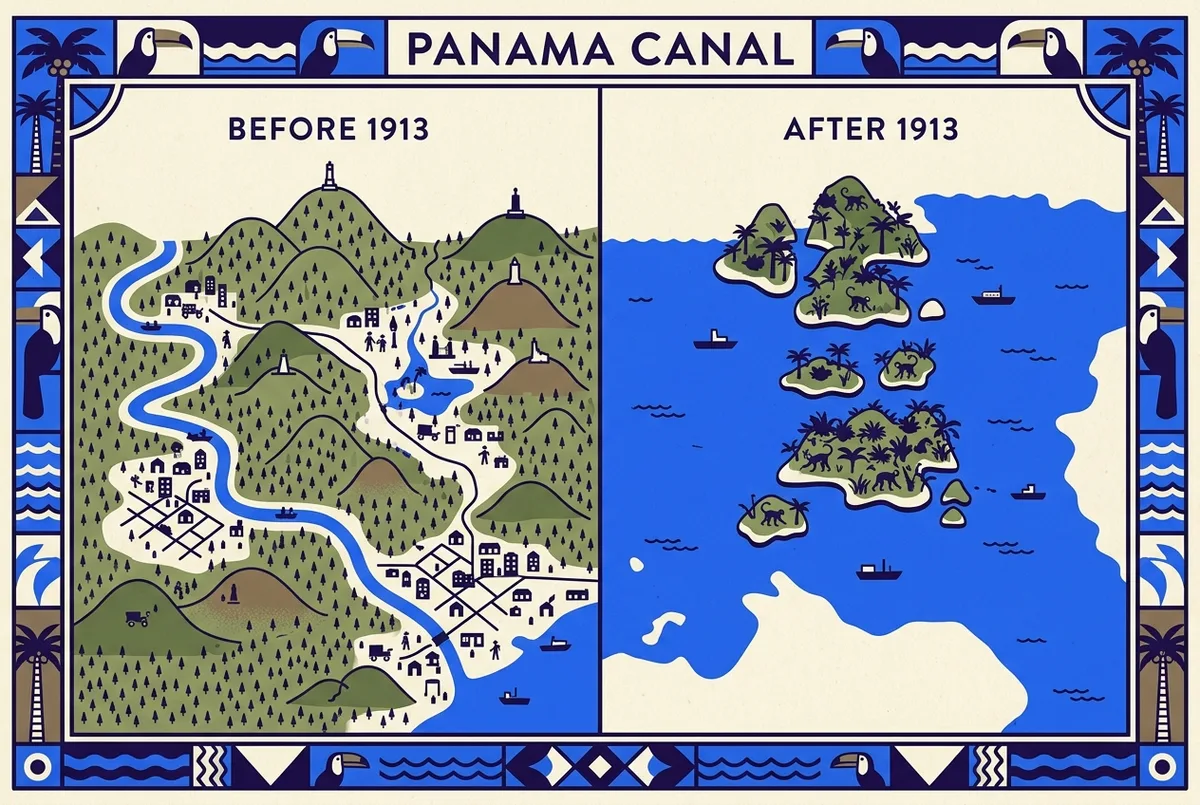
How did the monkeys get on Monkey Island? They did not get placed there by anyone. The islands in Gatun Lake that tour operators call Monkey Island are the tops of hills that were already forested and already home to wild monkey troops, long before the Panama Canal existed. When the canal’s builders flooded the surrounding valley in 1913, the water rose around those hills and never went back down, and the monkeys that happened to be living up high simply stayed put because there was nowhere else to go.
I think this is one of the more interesting backstories behind any wildlife stop in Central America, because it means you are not visiting a sanctuary, a release program or a zoo exhibit dressed up as nature. You are visiting the accidental byproduct of one of the largest engineering projects of the 20th century, and the monkeys you see are descendants of animals that were simply in the right place when the water came up.
What actually flooded to create Gatun Lake?
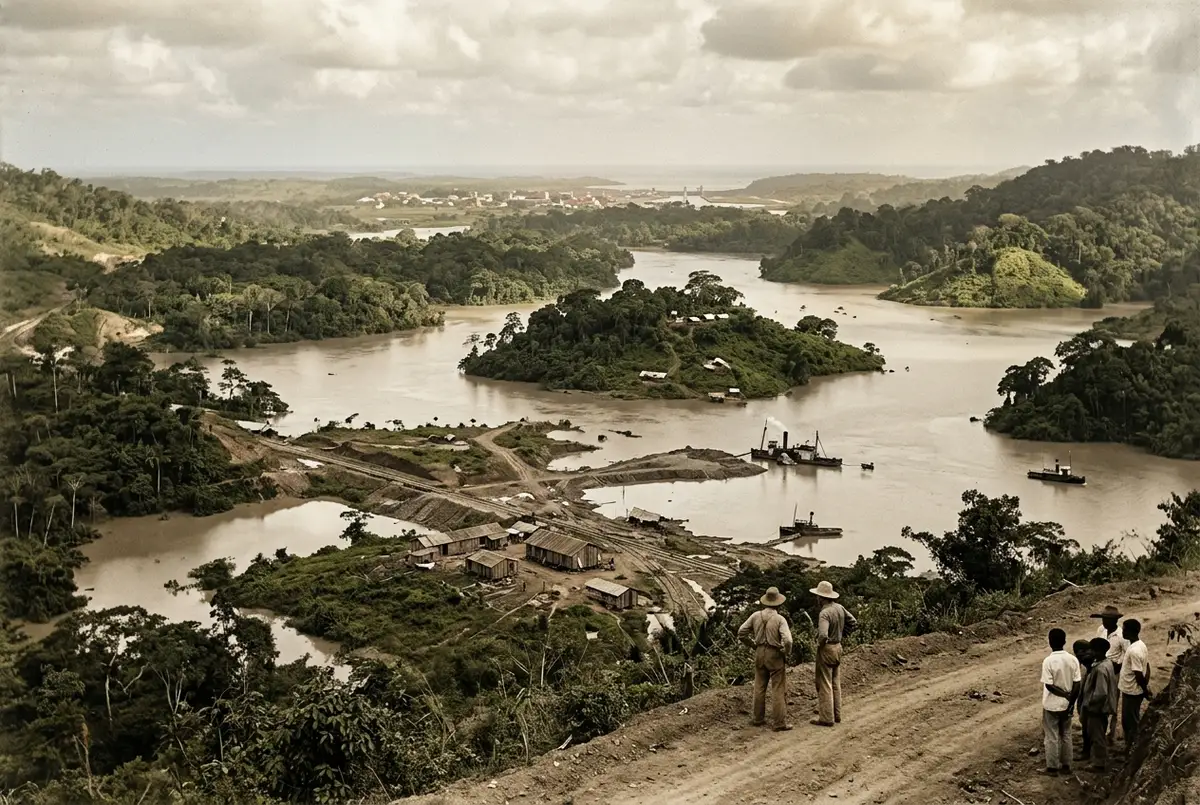
The Panama Canal’s engineers needed a way to lift ships over the continental divide without digging a sea-level channel the whole way across the isthmus, since that would have taken decades longer and cost far more. Their solution was to dam the Chagres River at Gatun, on the Caribbean side of the isthmus, and let the river back up behind the dam until it filled a wide valley and became a lake large enough to carry ships most of the way across the country.
That dam was finished in 1913, and the flooding it caused submerged roughly 164 square miles of what had been river valley and rainforest. Gatun Lake was, at the time, the largest artificial lake ever built, and parts of it are still a working shipping lane today. I would not undersell how dramatic that change was for everything living in the valley at the time. An entire forest ecosystem went from solid ground to islands and open water within a matter of months.
Check prices & dates
Ready to visit?
Book your tickets in advance: popular time slots sell out.
Some animals could and did relocate as the water rose, but monkeys are not strong swimmers and they are not built for crossing open water the way, say, a capybara or a caiman is. Troops that happened to be living on hills that stood higher than the final water line found themselves surrounded rather than displaced, and staying put on a shrinking patch of familiar forest was the safer option compared to attempting a swim across open lake water toward an unfamiliar shore.
My honest read on this is that the monkeys did not choose isolation so much as the geography chose it for them. A troop living on a hilltop before the flooding did not need to move anywhere, since their own territory simply became an island around them rather than requiring them to travel to a new one.
How long did the flooding actually take?
The Chagres River had been partially dammed as early as 1910, but the lake did not reach its final operating level until 1913, so the isolation of these hilltop forests happened gradually over roughly three years rather than overnight. I would not picture a single dramatic flood sweeping through the valley. It is closer to a slow-rising tide that crept up over seasons, giving wildlife time to retreat upward rather than being caught by surprise.
That gradual timeline matters for understanding why the resulting islands ended up with such a healthy, established population rather than a stressed, dying-off one. The monkeys were not trapped in a sudden disaster. They simply watched their accessible range shrink year by year until what was left was an island, and their population adapted to that smaller territory over the following decades.
Is there a documented, scientifically studied example of this exact process?
Yes, and it is one of the most famous field stations in tropical biology. Barro Colorado Island, a larger hill in the same lake system, became isolated the same way, and since 1923 it has been run as a protected research station by the Smithsonian Tropical Research Institute specifically because its isolation created a natural, long-running experiment in how a forest ecosystem behaves when it is cut off from the mainland.
I would point to Barro Colorado as the proof that this is a documented phenomenon, not folklore repeated by tour guides. The smaller hilltops that tour boats call Monkey Island were cut off by the exact same flooding event, just without the century of formal research funding that Barro Colorado received. The underlying mechanics, a hill losing its land bridge to rising water, are identical.
Did people ever consider moving the monkeys off the islands?
Not in any organized, large-scale way that I am aware of, and honestly I would not expect them to have tried. The canal project’s priority in 1913 was finishing a shipping route on schedule and budget, not managing wildlife on hilltops that were, at the time, a minor side effect of the engineering rather than a tourism asset anyone had reason to protect. The idea that these islands could become a wildlife-watching destination decades later was not on anyone’s radar.
What happened instead is that the isolated troops were simply left alone for most of the 20th century, which, somewhat ironically, is probably the best possible outcome for them. Limited human contact combined with a stable, enclosed territory let the populations settle into a predictable pattern that boat guides eventually learned to find reliably.
Does the isolation explain why sightings are so consistent today?
Yes, and I think this is the detail that actually matters if you are planning a visit rather than just curious about the history. A troop that cannot wander into unbroken mainland jungle is a troop that stays within a boat’s reach, visit after visit, season after season. The reasons Gatun Lake is the most reliable place near Panama City to see wild monkeys trace directly back to this same flooding event, so the history and the practical travel tip are really the same story told two different ways.
I would not treat a Monkey Island sighting as luck in the way you might treat spotting a rare bird in open jungle. These are resident populations confined by water, which is exactly why guides who run this route daily can point toward roughly the same stretches of shoreline trip after trip.
What species ended up isolated this way?
Three species show up consistently on the islands today: white-faced capuchins, mantled howler monkeys, and Geoffroy’s tamarins. I break down how to tell them apart on the water, since each one moves and sounds different enough that a few minutes of watching is usually enough to identify which is which.
I would guess that other small mammals went through the same isolation process on these hills, sloths and certain rodents among them, but monkeys are the animals tour operators built an entire category of excursion around, largely because they are visible, active during the day, and genuinely dramatic to watch move through a canopy from a slow-moving boat.
Is this story unique to Panama, or does it happen elsewhere?
It is not unique to Panama in principle. Any large dam that floods a valley can strand wildlife on the resulting high ground, and reservoirs around the world have created similar accidental islands. What makes Panama’s version notable is the scale of the canal project, the century of continuous observation that followed thanks to Barro Colorado’s research station, and the fact that a whole tourism category grew up around visiting the result.
I would call Gatun Lake’s islands one of the better-documented examples of this phenomenon anywhere in the tropics, precisely because the canal itself made the area so accessible and so heavily studied compared to a more remote reservoir elsewhere in the world.
Does knowing this history change how you should watch the monkeys?
I think it should, at least a little. These are not animals performing for visitors or habituated to a scripted encounter. They are a wild population shaped by an accident of 20th century engineering, still behaving the way monkeys behave anywhere else in the rainforest. The spotting tips I’d actually use on the boat treat the animals that way: patient, quiet, respectful of the fact that you are watching genuinely wild behavior rather than a managed show.
My honest advice is to let the history add context rather than expectation. You are not guaranteed a sighting of every species on every trip just because the backstory is interesting, but understanding why the monkeys are there at all tends to make the eventual sighting feel more meaningful than if you treated the islands as just another stop on a checklist.
Does the isolation affect how the monkeys interact with boats?
Somewhat. Decades of boat traffic passing near the shoreline, without feeding or landing, has made some troops, white-faced capuchins especially, comfortable enough to move closer to the water when a boat approaches rather than fleeing deeper into the canopy. I would not call this tame in the way a petting zoo animal is tame. It is closer to habituation to a predictable, non-threatening presence, which is a different thing entirely.
I would also gently push back on treating this as a sad story. The alternative to the canal’s flooding was never “the monkeys would have lived freely across an unbroken forest forever.” Panama’s rainforests have faced their own pressures over the past century regardless, and the isolated, protected populations in Gatun Lake have, if anything, done better than many mainland troops facing habitat loss from other causes.
Once you understand that nobody stocked these islands on purpose, a Monkey Island boat tour in Panama stops feeling like a managed attraction and starts feeling like what it actually is: a chance to watch a wild population that history happened to make unusually easy to find.
FAQ
Did someone release monkeys onto these islands on purpose?
No. The monkeys were already living on the hills before the Panama Canal’s builders flooded the surrounding valley in 1913. The flooding isolated them; it did not introduce them.
When exactly did the flooding that created Monkey Island happen?
The Gatun Dam that created Gatun Lake was completed in 1913, after a damming process that began around 1910, so the hilltops became islands gradually over roughly three years.
Is Barro Colorado Island the same place as Monkey Island?
No, but it was created by the exact same flooding event and sits in the same lake. Barro Colorado is larger and has been a formal Smithsonian research station since 1923, while the islands tour operators call Monkey Island are smaller hilltops nearby.
Are the monkeys on Monkey Island considered a separate species from mainland Panama monkeys?
No. They are the same species found elsewhere in Panama’s forests, capuchins, howlers and tamarins among them, just isolated on the islands by the lake rather than being a distinct population.
Could the monkeys ever leave the islands on their own?
It is extremely unlikely for most individuals. Open water is a serious barrier for these species, so the troops have remained on their respective islands for generations rather than migrating back to the mainland.
Panama Canal Monkey Island Wildlife SafariFrom €32