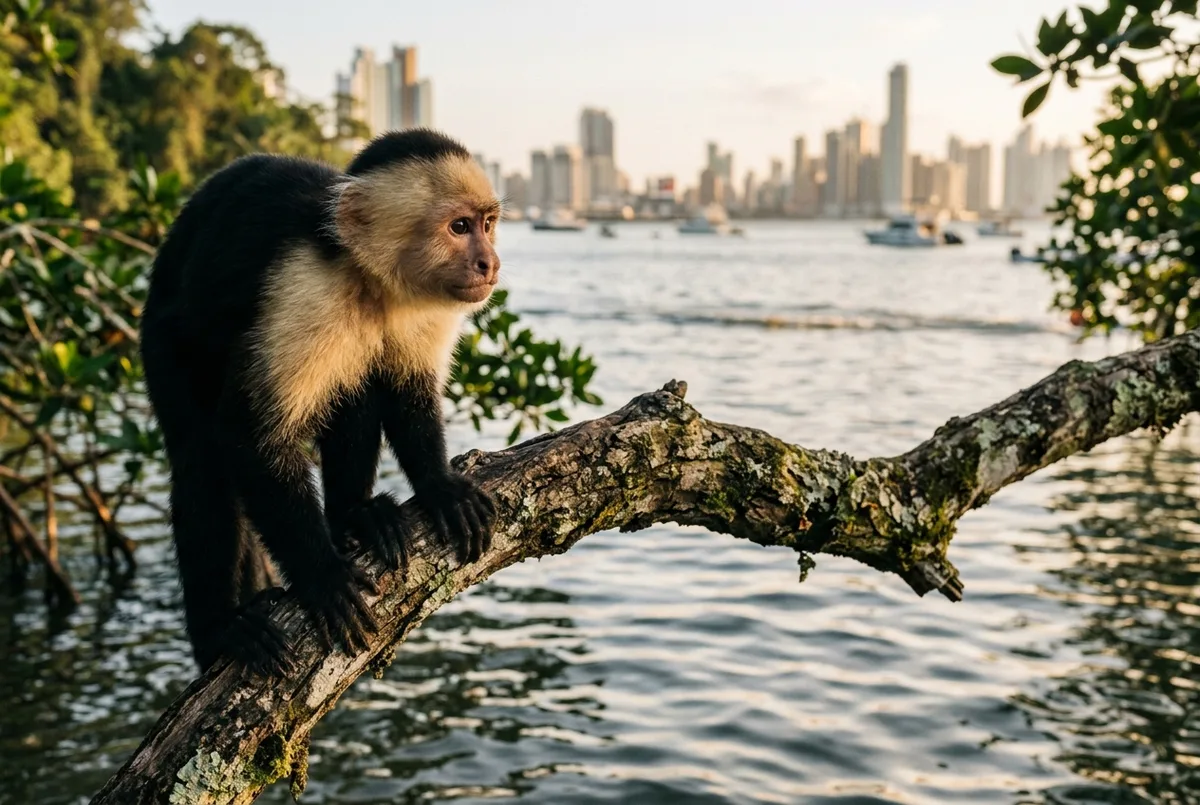
There are three types of monkeys in Panama that you’ll actually see on a Monkey Island boat tour: the white-faced capuchin, the mantled howler, and Geoffroy’s tamarin. I think the fastest way to enjoy the trip more is to learn these three before you go, because spotting a specific species feels a lot more satisfying than just seeing “some monkeys” go by.
Each species has a distinct look, a distinct size, and a distinct way of moving through the trees, so once you know what to look for, telling them apart from a moving boat gets easy fast. If you want the bigger picture first, the full guide to monkeys of Panama covers where these species live and why Gatun Lake’s islands are the place to find them.
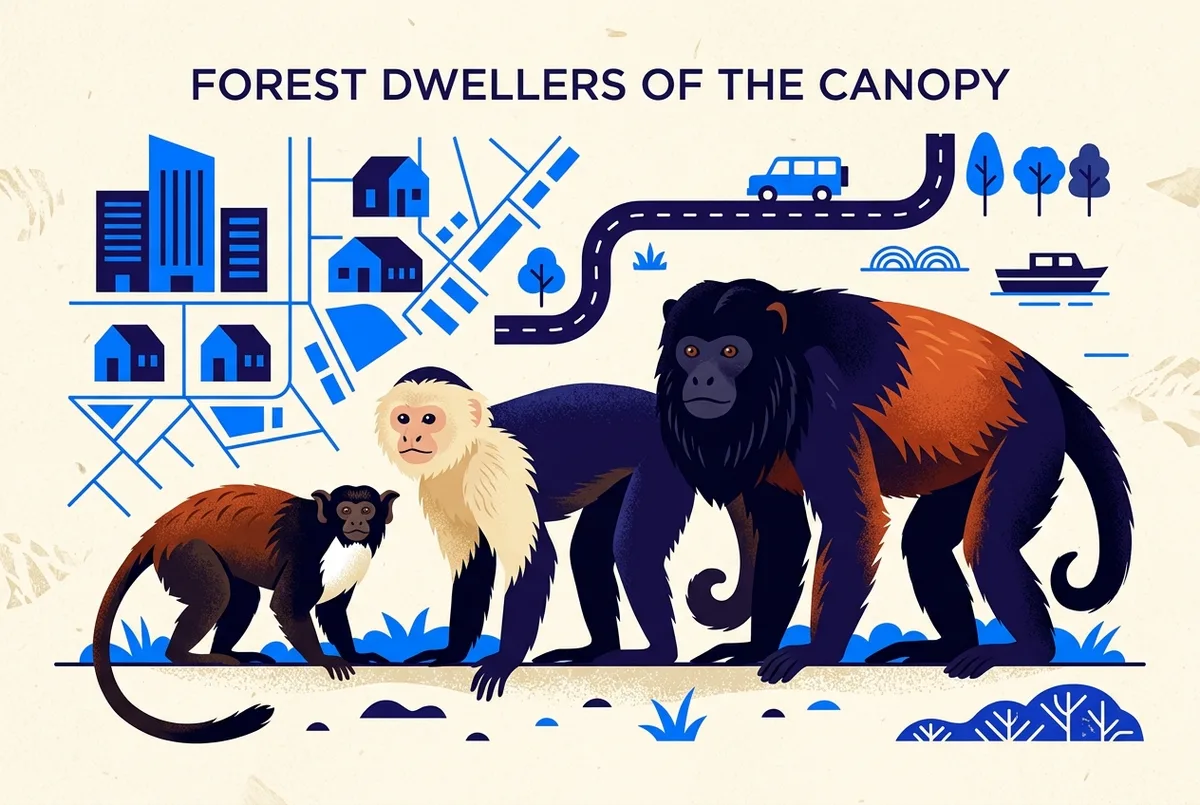
What does a white-faced capuchin look like?
A white-faced capuchin is mid-sized, with a dark brown or black body and a pale cream or white face, throat and shoulders that give the species its name. They move in loose, active troops of a dozen or more and travel fast and low through the branches, often dropping down toward the water’s edge when a boat approaches.
I would call this the species to watch for first. Capuchins are the most consistently visible of the three on these tours, since they are naturally curious and will often come toward the shoreline rather than retreating into the canopy. Guides on the standard Gatun Lake boat tour report capuchin sightings on nearly every departure.
What does a mantled howler monkey look like?
Mantled howlers are the largest of the three species, with a stocky black body and a fringe of longer golden-brown fur along the sides, which is where the “mantled” name comes from. They move slowly and tend to stay high and still in the canopy, which actually makes them harder to spot visually than the smaller, more active capuchins.
What gives them away is sound, not sight. Their roaring call, which can travel well over a mile across open water, is one of the loudest animal sounds in the Americas relative to body size. My honest advice is to listen as much as you look. If you hear a deep, rolling roar before you see any movement, that is almost certainly a howler announcing its territory.
What does a Geoffroy’s tamarin look like?
Geoffroy’s tamarin is the smallest of the three species, with a mix of black, white, reddish and orange fur and a notably long tail relative to its small body. Tamarins move in quick, darting bursts through the lower and middle branches, closer to the water than howlers typically sit.
I would not expect to see tamarins on every single tour the way you might with capuchins. They are smaller, faster, and easier for a casual glance to miss entirely. If a sighting of this specific species matters to you, mention it to your guide at the start, since an experienced eye can often pick tamarin movement out of the foliage well before a first-time visitor would notice anything at all.
How can you tell the three species apart quickly on the boat?
Size is your fastest clue. Howlers are clearly the biggest, capuchins are mid-sized, and tamarins are noticeably the smallest of the three. Color helps next: howlers are mostly black with a golden fringe, capuchins have that distinctive pale face and shoulders, and tamarins show the most mixed coloring of black, white and reddish tones.
Behavior is the final tell. If an animal is loud, slow and sitting high and still, it is a howler. If it is actively moving low and fast and seems curious about the boat, it is almost certainly a capuchin. If you catch a small, quick blur low in the branches that is gone before you can look twice, that is most likely a tamarin.
Does the species mix vary from tour to tour?
Not really. Every tour that stops at these islands is pulling from the same resident troops, since they are all visiting the same general stretch of Gatun Lake shoreline rather than different locations entirely. A longer, pricier combo tour does not mean a better selection of species, it usually just means more activities bundled around the same wildlife stop.
Where the tours genuinely differ is time spent at the sighting itself and how experienced the specific guide is at reading movement in the canopy. I would rather book a tour with strong reviews for its guiding than assume a higher price automatically buys a better species mix, since the three species available do not change based on which boat you book.
Do all Monkey Island tours let you see all three species?
Most do, but sightings are never guaranteed for any single species on any single outing, since these are wild animals moving on their own patterns, not a scripted show. I cover realistic sighting odds and where else in Panama to look if the boat tour comes up short on a given day in more detail.
What I can say confidently is that capuchin sightings are close to a sure thing on a normal outing, howler calls are nearly as reliable even when the animals themselves stay hidden, and tamarins are the species most likely to require a bit of luck and a sharp-eyed guide.
Why do these three species end up living together on the same islands?
The explanation goes back to how Gatun Lake itself was formed. I walk through the full history of the 1913 flooding that isolated these populations on the origin-story page, but the short version is that all three species were already living on the same forested hills before the valley flooded, so when the water rose, they stayed neighbors on the same shrinking patch of high ground.
That shared history is actually part of what makes the sightings interesting. You are not watching three species that were introduced together artificially. You are watching three species whose overlapping ranges simply got concentrated by an engineering project, which is a genuinely unusual story for a wildlife stop this close to a major city.
What is Monkey Island itself, if it’s not one single island?
If the whole concept of “Monkey Island” is new to you, it helps to understand what the name actually refers to before you dig into species identification. The full explanation of what Monkey Island is and where it sits in Gatun Lake is on this dedicated page, including why the name applies to a cluster of islands rather than one single piece of land.
Is this the same species mix as the Monkey Island near Bocas del Toro?
No, and this is a common point of confusion. The islands near Bocas del Toro that also go by the Monkey Island nickname are a separate location with a different story, so do not assume the species you learn here will match what you might hear about on the other side of the country.
What is the best way to actually photograph each species?
Capuchins move fast, so a faster shutter speed and a willingness to take several shots in a row works better than trying to time one perfect frame. Howlers sit still for longer stretches, which makes them the easiest of the three to photograph well if you can locate one in the canopy. Tamarins are genuinely difficult, since they are small, quick and often partly hidden by leaves, so I would not stress over getting a clean tamarin photo and instead just enjoy spotting one with your own eyes.
Practical tips on seating position, timing and equipment for the whole outing are covered on the wildlife spotting tips page, which goes further into gear and boat positioning than this identification guide does.
FAQ
Which type of monkey is easiest to see in Panama?
The white-faced capuchin is the easiest to spot reliably on a Monkey Island tour, since the species is active, curious and tends to move toward the shoreline when a boat approaches.
Are howler monkeys dangerous to be near?
No, howlers are not aggressive toward boats or visitors who keep a respectful distance. Their loud call is a territorial signal to other animals, not a warning aimed at humans.
How big is a Geoffroy’s tamarin compared to the other species?
A Geoffroy’s tamarin is noticeably smaller than both the capuchin and the howler, roughly the size of a squirrel, which is part of why it is the hardest of the three to spot from a moving boat.
Can you see all three species on a single short boat trip?
It’s common but not guaranteed. Capuchins and howler calls are the most consistent, while a tamarin sighting depends more on timing and a sharp-eyed guide.
Do the three species ever interact with each other?
They share the same forested islands and sometimes the same stretches of canopy, but each species largely keeps to its own troop and does not actively socialize across species lines.
Once you can tell the three species apart, the identification itself stops being the hard part of the trip. A Panama Monkey Island tour still comes down to picking the right departure for your schedule and budget, and I’d rather you spend your planning time on that than worrying about which monkey is which once you’re actually on the water.