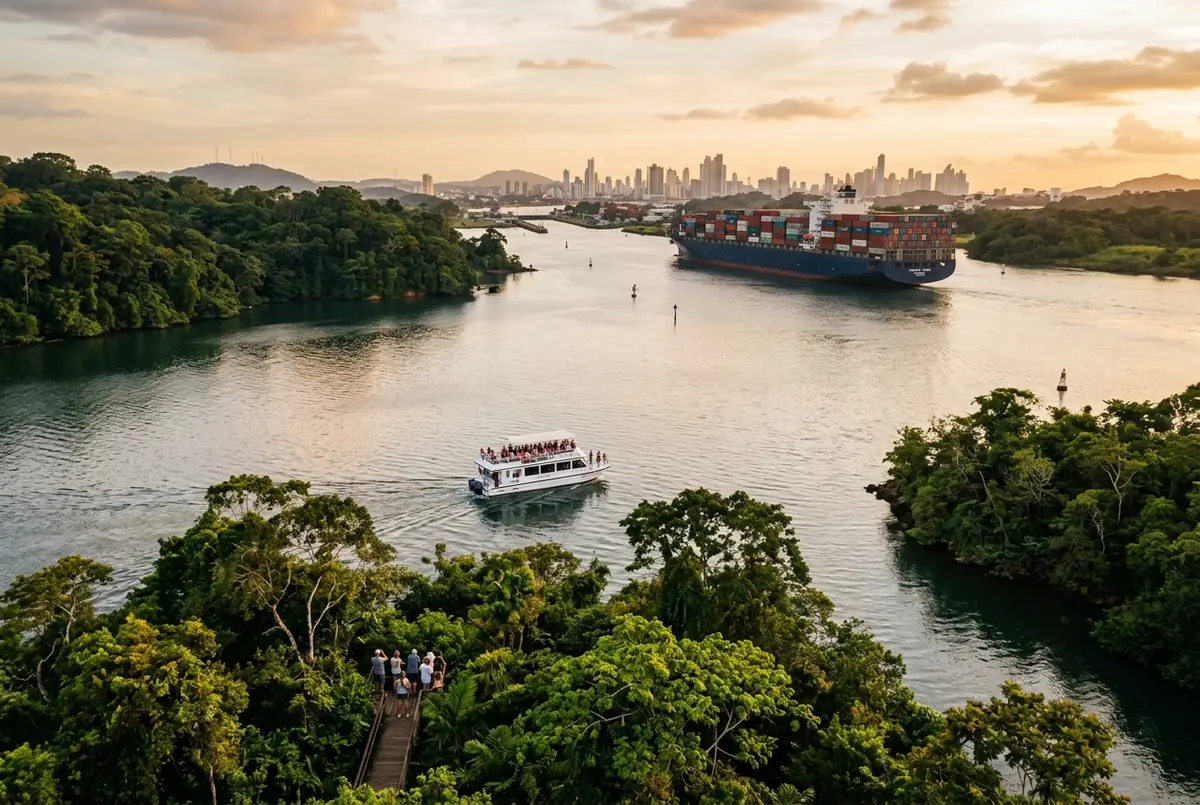
Monkey Island and the Panama Canal are not two separate attractions that happen to sit near each other. The islands that tour operators call Monkey Island are physically inside Gatun Lake, and Gatun Lake is the Panama Canal’s largest reservoir, still crossed daily by the cargo ships and cruise liners that use the canal to cut weeks off a trip around South America. I would stop thinking of these as two different day trips, because for most visitors, they are the same boat ride.
That overlap is the whole reason a wildlife-watching tour out of Panama City can also hand you a decent view of an active shipping lane, and it is why several tours on the market combine canal sightseeing, like a stop at the Miraflores Locks Visitors Center, with the wildlife stop at the islands rather than treating them as competing itineraries. If you want to see exactly how the eight tours running this route split up the canal and wildlife angles, comparing all eight by price, duration and what each one bundles in is the fastest way to decide which one fits your day.
How exactly is Monkey Island part of the Panama Canal?
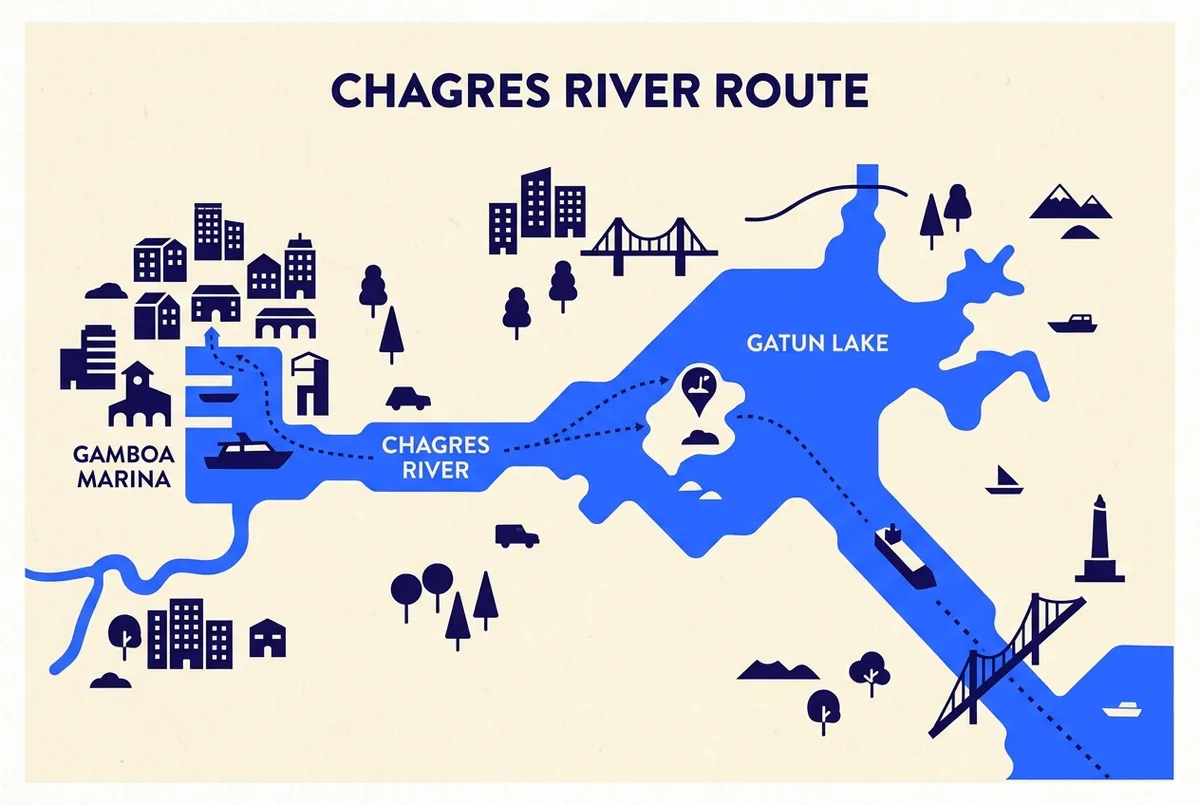
The islands sit in Gatun Lake, a man-made reservoir created in 1913 when the canal’s builders dammed the Chagres River. That dam raised the water level across a wide valley, and hilltops that had been part of the mainland forest became isolated islands once the flooding settled. I go into the full flooding story and why the monkeys ended up trapped there rather than relocated, but the short version for this page is that the lake itself is not a separate body of water near the canal. It is a working section of the canal route that ships still use today.
I think this is the detail most first-time visitors miss. You are not visiting “a lake near the canal” when you book a Monkey Island tour. You are crossing a genuine stretch of the Panama Canal, just a part of it that happens to also hold a resident monkey population on its scattered islands.
Do ships actually still use Gatun Lake today?
Yes, constantly. Gatun Lake forms roughly a third of the canal’s total length, and every ship transiting between the Atlantic and Pacific sides crosses it as part of the standard route, after being lifted up through the Gatun Locks on one side and before being lowered back down through Pedro Miguel and Miraflores on the other. Boat tours heading to Monkey Island travel the same open water these cargo ships use, just on a smaller, slower vessel built for sightseeing rather than freight.
My honest take is that this is one of the more underrated parts of the whole experience. You get genuinely close to a working piece of global shipping infrastructure, with ships that can be longer than two football fields passing at a comfortable, safe distance, on the same outing where you are also watching wild monkeys move through the canopy. Few wildlife tours anywhere in the world let you combine those two things in one boat ride.
Why did the canal’s builders flood this particular valley?
The canal needed a way to lift ships over Panama’s continental divide without digging a sea-level channel the entire way across the isthmus, which would have taken far longer and cost dramatically more to build. Damming the Chagres River and letting it back up into a lake solved that problem by giving ships a stretch of calm, elevated water to cross between the lock systems on either side. I would call this one of the more elegant engineering solutions of the early 20th century, even though its side effect, stranding wildlife on hilltops, was clearly not the point of the project.
That flooding is also directly responsible for why Monkey Island tours exist as a category at all. Without the canal, there would be no Gatun Lake, no isolated hilltop islands, and no reliable wildlife stop for boat operators to build a half-day tour around.
Can you combine a canal-focused tour with the wildlife stop in one trip?
Yes, and several tours on the market are built specifically to do this. The Panama Canal Monkey Island wildlife safari pairs a safari truck ride through Soberania National Park with the boat crossing to the islands, giving you canal-adjacent scenery and the monkey sighting in one five-hour outing at one of the lower price points in the lineup. The Monkey Island and Miraflores Locks tour goes further on the canal side specifically, bundling in a guided visit to the Panama Canal Visitors Center where you can watch an actual lock transit before the boat portion begins.
I would pick between these based on which half of the experience matters more to you. If you want the full engineering story, locks included, the Miraflores combo earns its higher price. If you would rather spend your money and time on more wildlife and nature rather than a museum stop, the safari combo or the plain Gatun Lake boat tour make more sense.
What does “isla Gatun” actually refer to?
Isla Gatun, or Gatun Island, is a name sometimes used for parts of the same island cluster inside Gatun Lake that boat tours visit for the monkey sightings. It is not a separate destination from what this site covers. I would treat any reference to Isla Gatun as describing the same general area, the forested hilltop islands inside the canal’s largest reservoir, rather than assuming it points you toward a different attraction entirely.
This is a good example of how many different names end up pointing at the same water. Gatun Lake, Isla Gatun, and Monkey Island are all describing overlapping or identical geography, which I understand is confusing from a search results page, but it becomes simple once you know the canal and the lake are one connected system.
Does visiting Monkey Island mean you’ll see the famous locks too?
Not automatically, and this is worth being clear about before you book. The plain boat tours and the safari combo cruise Gatun Lake’s open water but do not transit or stop at the actual Miraflores or Gatun locks. If seeing a real lock transit matters to you specifically, you want a tour that explicitly includes a Visitors Center stop, like the Miraflores combo mentioned above, rather than assuming any Monkey Island tour covers the locks by default.
I would double check a tour’s exact inclusions before assuming you are getting both the locks and the wildlife. The listings are specific about this, and reading the itinerary rather than just the title is the easiest way to avoid a mismatched expectation on the day.
Is the canal connection the reason prices vary so much between tours?
Partly. Tours that add a dedicated canal landmark, like the Miraflores Visitors Center, tend to cost more than the tours that stick to open-water Gatun Lake crossings, since the extra entrance fee and the longer itinerary both add to the price. I would factor this into your decision rather than assuming a higher price automatically means a better wildlife sighting, since the core monkey-watching stop is essentially identical across every tour on the market.
My honest advice is to decide first whether the canal’s engineering side genuinely interests you. If it does, the premium for a locks visit is worth paying. If you are purely here for the monkeys, a plainer and cheaper boat tour delivers the same wildlife experience without the added cost.
Does the canal’s shipping traffic ever interfere with the wildlife sighting?
Not in any way I would worry about. Gatun Lake is wide enough that shipping lanes and the shoreline areas where monkeys live do not overlap in a way that disturbs either activity. Guides know how to route the boat so you get a good look at both a passing ship, if timing works out, and the monkeys at the islands, without one experience crowding out the other.
I would call this one of the more pleasant surprises of the trip. Rather than feeling like an industrial detour bolted onto a nature tour, the shipping traffic tends to add a genuine sense of scale and context to the whole outing, since you are watching wild animals live successfully on the edge of one of the busiest shipping routes on earth.
Should you book the canal angle or the wildlife angle first when deciding?
I would start with the wildlife, since that is the part every single tour delivers consistently regardless of price. Once you have settled on wanting the Monkey Island sighting, then decide how much of the canal’s engineering story you want layered on top, whether that is nothing extra, a safari truck detour through the national park, or a full Miraflores Visitors Center stop.
This order of decisions tends to produce a better outcome than starting from the canal side, since a few visitors end up overpaying for canal content they could have gotten more cheaply on a dedicated Miraflores-only tour that skips the wildlife entirely, if the monkeys were never really the priority in the first place.
How do the prices actually compare across the canal-linked tours?
Here is the real spread, based on the current listed prices for the tours that touch both the canal and the wildlife stop. The plain Gatun Lake boat tour starts at €53 for 4.5 hours and sticks to the open-water crossing with no extra canal landmark. The Panama Canal Monkey Island wildlife safari starts at €32 for 5 hours and adds a safari truck ride through Soberania National Park, though it carries a separate $20 national park entrance fee paid in cash. The Monkey Island and Miraflores Locks tour starts at €107 for 5 hours and is the one that actually includes a guided stop at the canal’s locks, with that entrance folded into the online price rather than charged separately.
I would read that spread as three different answers to three different questions, not a simple cheap-to-expensive ladder. The safari tour is the best value if you want more activity for less money and do not mind a cash fee at the gate. The plain boat tour is the leanest option if you only want the wildlife and nothing else. The Miraflores combo is the one to pick specifically because it includes the locks, and paying more for that inclusion is the whole point of booking it over the cheaper options.
Is there a deeper historical link between the canal and these specific islands beyond the flooding?
Yes, and it goes beyond just Monkey Island. Barro Colorado Island, a larger hill in the same lake system, was isolated by the identical 1913 flooding and has been run as a Smithsonian research station since 1923 specifically because its isolation created a natural laboratory for studying an ecosystem cut off from the mainland. I would call it the more famous, more scientifically documented sibling of the smaller islands that tour boats visit for monkey sightings.
That connection matters here because it confirms the whole premise of this page with outside, peer-reviewed research rather than just tour-guide folklore. The canal’s flooding did not just create a reservoir for shipping. It created an entire archipelago of accidental islands, each shaped by the same event, with Monkey Island being the most accessible and most frequently visited of the group rather than a one-off curiosity.
What should you read next if the canal history itself interests you?
The specific lock systems that make the canal work, Gatun, Pedro Miguel and Miraflores, and how many there actually are is the natural next page if the engineering side of this story is what pulled you in. It fills in the mechanical half of what makes the lake you’ll be boating across actually function as a shipping route.
If you came here mainly for the monkeys and the canal connection was just a bonus fact, the fuller picture of the species living on these islands and why Gatun Lake is the easiest place near Panama City to find them is probably more useful to you than the engineering detail.
Is one trip really enough to cover both the canal and the wildlife properly?
For most visitors, yes. A half-day boat tour gives you a genuine look at both the canal’s scale and the monkey populations living inside its largest lake, and I would not feel like you are shortchanging either side by keeping it to one outing. Visitors with a deeper specific interest in canal engineering might still want a separate, dedicated Miraflores-only visit on another day, but that is a matter of depth, not a sign that the combined trip is somehow incomplete.
My honest recommendation, after looking at how every tour on this route is actually built, is to treat the canal and the wildlife as one connected story rather than two competing bookings. A Panama Monkey Island tour from the city already gets you both halves of that story in a single afternoon, which is a better use of a limited Panama City itinerary than splitting them into separate trips.
FAQ
Is Monkey Island literally part of the Panama Canal?
Yes. The islands sit inside Gatun Lake, which is the canal’s largest reservoir and still used by ships transiting between the Atlantic and Pacific.
Do Monkey Island tours pass through the actual canal locks?
Not by default. The standard boat tours cross open water on Gatun Lake but do not transit the Miraflores or Gatun locks unless you book a tour that specifically includes a Visitors Center stop.
Is Isla Gatun the same place as Monkey Island?
Isla Gatun generally refers to the same general island cluster inside Gatun Lake that tour boats visit for wildlife sightings, not a separate destination.
Will I actually see a cargo ship on a Monkey Island tour?
It depends on timing, since ships transit on their own schedule, but Gatun Lake is an active shipping lane, so a passing ship is a realistic possibility on any given crossing.
Does a canal-focused combo tour cost more than a plain wildlife tour?
Usually, yes. Tours that add a dedicated canal landmark, like the Miraflores Visitors Center, tend to list higher prices than the plain Gatun Lake boat crossings because of the added entrance fee and longer itinerary.